
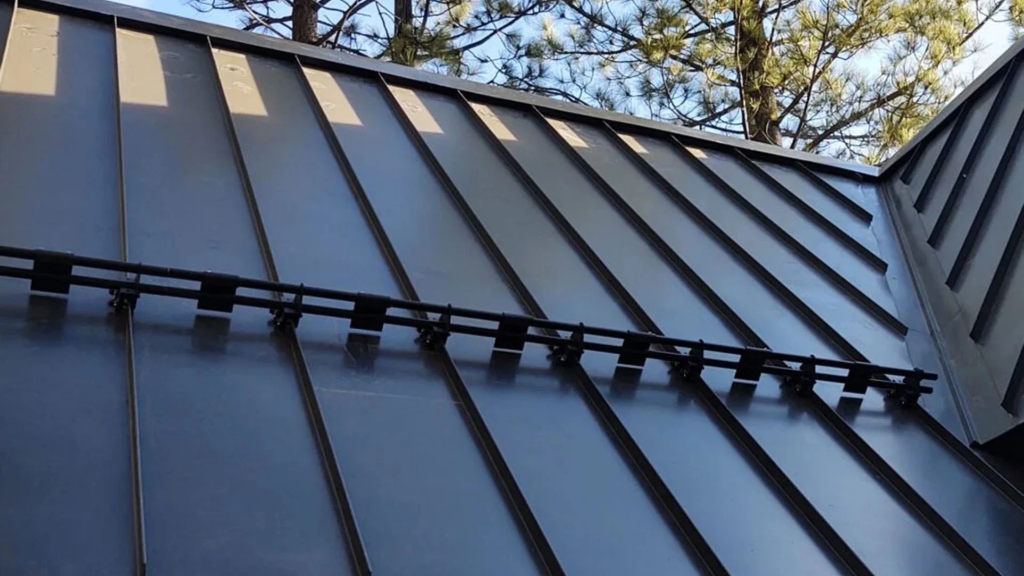
Snow and ice falling off your roof can be dangerous. Especially if it’s onto your front steps, or your driveway, or your patio or deck.
That’s when snow guards for metal roofs become an important consideration.
Snow guards help protect your family and visitors, plus cars and other property, from being injured or damaged by falling snow.
We’ve supplied snow retention systems to contractors and homeowners throughout the US. But before choosing a specific snow guard system, you want to account for your roof’s specs, local snow conditions, any local regulations, and what sits below the places that snow tends to fall.
This article walks you through the basics so you can know what to ask your roofing contractor and how to make the best choices for your home.
When Does a Metal Roof Need Snow Guards?
Snow retention is worth evaluating when snow can accumulate on a metal roof and slide into an occupied or vulnerable area. Three considerations help establish the need.
What’s below the roof? Start with entrances, walkways, decks, parking spaces, and equipment. Consider lower roofs, too. An upper roof that sheds snow onto a porch roof presents a different concern than one overlooking an unused part of the yard.
What are the conditions at your property? Elevation, exposure, and local snowfall matter more than a broad regional label. A mountain home and a nearby valley home may face different conditions. Tell your contractor about previous slides, drifting, or places where snow collects.
How is the roof shaped? Pitch, the distance from eave to ridge, valleys, and changes in roof height all deserve attention. Valleys and roof transitions can concentrate snow. Don’t assume that a relatively shallow pitch eliminates sliding risk.
A recommendation to add snow retention is also different from a code requirement. Ask your contractor to confirm applicable local requirements with the building department and identify any needed design review.
If you’re planning a new roof, raise these questions before ordering. That gives the team time to coordinate the panels, attachments, and retention layout.
Individual Snow Guards vs. Snow Rails
Metal roof snow retention generally falls into two families: individual devices and continuous rail or fence systems. Both need a layout suited to the roof and the expected loads.
Individual snow guards
Individual guards, sometimes called snow stops or cleats, are separate devices distributed across the roof. Depending on the system, they may appear as a pattern of small projections between or along the panel seams.
Their individual size doesn’t tell you how many you’ll need. A few scattered guards aren’t a substitute for a designed arrangement. Ask to see the proposed quantity and placement before deciding whether you like the appearance.
Continuous rails or fences
Snow rails for metal roofs use connected bars or rails supported by brackets or clamps. They form a horizontal line across the roof and may require additional rows farther up the slope.
Neither system family is universally better. The important question is whether the complete assembly can handle the forces for your project and transfer them safely into the building.
How to Choose a System for Your Metal Roof
A system that looks right in a photo may not fit your panels or meet your project’s requirements. Work through these three checks with your contractor.
1. Identify the exact roof panel
Confirm the panel manufacturer and profile, metal type, gauge, and seam or rib geometry. Two roofs that look similar from the driveway can require different attachments.
Our guide to metal roof styles and fastening systems can help you recognize the broad roof categories. For a Nu-Ray roof, use our panel specifications and technical resources to narrow down the details.
If you don’t know the panel name, start with your original roofing paperwork or photos. Your contractor may need to verify it on site.
2. Confirm the attachment method
Compatible standing seam snow guards may use clamps that grip the raised seam without penetrating the metal. Compatibility still depends on the particular clamp, seam shape, panel material, and tested holding strength.
Exposed-fastener roofs may use mechanically attached brackets with approved fasteners and weatherproofing details. The attachment must suit the roof assembly and the support beneath it.
“Fits standing seam” or “works on metal roofing” isn’t enough information to buy confidently. Ask for confirmation that the proposed attachment is suitable for your exact panel and preserves the roof’s required movement and weather resistance.
3. Confirm the design and layout
The design needs project-specific information: roof snow load, pitch, seam spacing, roof width, and the distance from eave to ridge. Those inputs must be evaluated against tested component capacities.
Don’t assume one row near the eave will be sufficient. Likewise, an entryway concern doesn’t necessarily call for a short section directly above the door. Snow from a wider area can load that section, so the designer needs to consider the entire contributing roof area.
Ask who will provide the layout and calculations, and whether an engineer’s review is needed. Your contractor should confirm these responsibilities before installation.
What Affects Snow Guard Installation Cost?
The useful comparison is the price of a complete installed system. A low price per guard tells you little without knowing how many guards, attachments, and rows your roof needs.
The main cost drivers include:
- System type and quantity: Individual guards, rails, supports, and any additional rows.
- Attachment requirements: Components compatible with your panel and roof assembly.
- Roof access and complexity: Height, pitch, intersecting roof areas, and installation labor.
- Design and roof condition: Required documentation, technical review, and repairs needed before installation.
When comparing quotes, ask each contractor to identify the product, attachment method, areas covered, and basis for the layout. Confirm whether design work and any repairs are included. Two quotes may look very different because they cover different amounts of work.
What to Gather Before Requesting a Recommendation
You don’t need every measurement to begin a conversation. Bring what you have:
- Your project location.
- The panel name, or clear photos if it’s unknown.
- Roof dimensions and pitch, if available.
- The entrances, paths, parking areas, or other features below the roof.
- Whether you’re planning a new roof or adding retention to an existing one.
Photos taken safely from the ground can help explain the concern. Your contractor can obtain any measurements that require roof access.
Contact Nu-Ray to discuss available snow-retention products and compatibility with our panels. Then have a qualified contractor confirm the project’s design requirements, roof condition, and installation plan.
Frequently Asked Questions
Can you add snow guards to an existing metal roof?
Yes, retrofit options may be available. The roof’s condition, exact panel, and attachment requirements determine what’s suitable. Compatible clamp-mounted systems can sometimes be added without penetrating standing seam panels. Before ordering, have a contractor inspect the roof, confirm the proposed system’s compatibility, and obtain a layout for the project.
How many snow guards do I need, and how far apart should they be?
There’s no universal quantity or spacing. The answer depends on roof snow load, pitch, dimensions, seam spacing, and the capacity of the selected system and attachments. Use a project-specific layout based on verified information. Copying a neighbor’s arrangement or a generic online diagram can leave important differences unaccounted for.
Will snow guards damage my roof or affect its warranty?
Incorrect attachments or installation can damage panels, create leaks, or affect warranty coverage. A clamp-on system avoids roof penetrations, but that alone doesn’t establish approval or preserve every warranty. Confirm the attachment and installation requirements with the relevant manufacturers, and review roof, finish, and accessory warranties separately before work begins.
Do snow guards increase the amount of snow a roof can support?
No. Snow guards help control sliding snow; they don’t strengthen the roof or increase its structural load capacity. Because the system is intended to retain snow, the evaluation must account for the roof’s ability to support it. If that capacity is uncertain, have a qualified structural professional review it before installation.